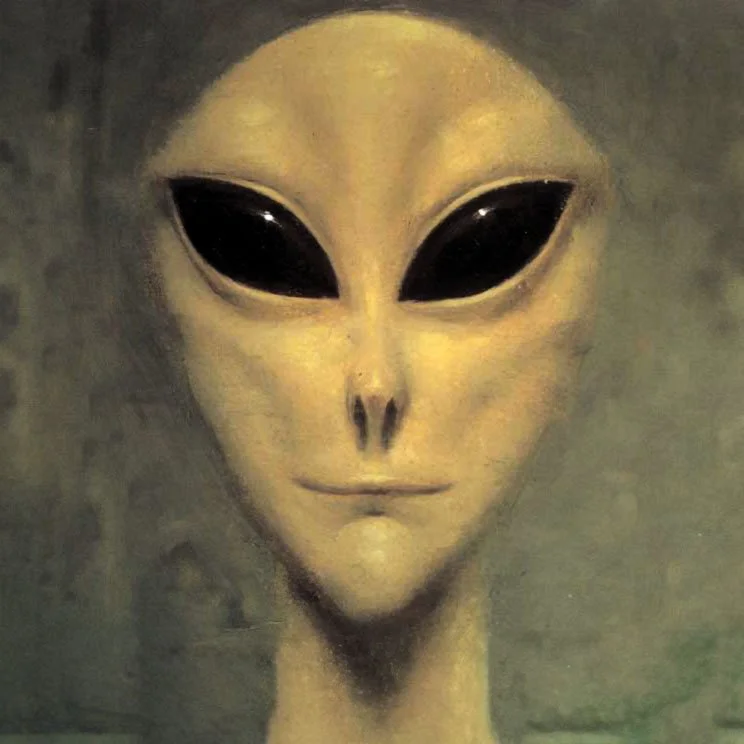
As a child I had an intense phobia—and fascination—with aliens. Throughout my childhood they had quite a moment in pop culture. Of particular note was the Grey, that most recognizable of forms of alien, with large heads and big, black eyes.

The Grey was my first wrathful deity—not that I saw it that way then. It was just terror, with a strange gravity that kept drawing me back. The very depiction of these things was enough to send intense fear and panic through my body. It was a paralyzing fear, felt especially if I were to have a nightmare or a night terror involving this form. I would be half-awake, paralyzed, trying to scream but unable. Watching a TV show or movie showing Greys would be enough to give me those nightmares. As terrifying it was to experience this as a kid, I’ve learned, I’m not alone in this fear.
I have to be clear: I have never believed that I have been abducted, contacted, or visited by entities like this. In fact, when I’ve searched for information or insight into the intricacies of this fear and mythology, the obsession over its factuality or lack thereof frustrated and annoyed me. The point isn’t whether the Grey exists in some hangar in Nevada. The point is that it exists in the nervous system, in the imaginal field, and in the way it bends the mind toward and away from truth.
These days, I hold to this fascination not as a live, ongoing interest, but as an artifact of a formative period of my life that sheds light on much of my present experience of consciousness. What this mythology speaks to is the nature of the uncanny, the power of primal, numinous fear, and the role of the esoteric in excavating structures of mind that operate on mythic, primeval registers. From the lens of Buddhist practice, I find this captivating; from the lens of Western Buddhist practice, so often shaped by rationalism and rejection of the superstitious, I find this illuminating. Here in the West, we get caught on the question, “Is it real?” But Buddhist practice has given me another question to ask: “What is its function? What work does it do in the mind?”
The term high strangeness comes to mind—the quality of phenomena that are bizarre, hard to explain, and beyond conventional understanding. It’s that which shocks us out of the habituated patterns of perception and interpretation. To see an alien such as the Grey, either hovering over you in an alien abduction, or dead on a stretcher in a government hangar, wouldn’t just be a phenomenon that would startle, but would radically upend one’s entire metaphysical view of existence in a single moment with no safety net to fall back on. For a child as open to suggestion as I was, my body and nervous system felt the shock of that even as it was presented as fiction.
Direct, unmediated insight into reality (vipassanā), a primary function of Buddhist meditation, often has this quality to some degree or another. “Insight” doesn’t just mean finding deep information, but seeing, without filter, existence as it is. That means the direct perception of impermanence (anicca), the reality of there being no solid, continuous, essential self (anatta), and general dissatisfaction and suffering in life (dukkha). Often described as “luminosity,” it is overwhelming and raw until one has trained oneself to hold that insight. To see these realities as they are can be profoundly unsettling. Seeing how dream-like and constructed one’s literal perceptions of the world are, down to sensory experience itself, can destabilize a psyche that is not ready.
Buddhist sources are rife with examples. All the way back in the Pali canon, as in the Saṃyutta Nikāya, awakening carries a shocking quality in which meditators experience “fear and trembling” (bhaya) at breakthrough moments. In Zen, as spoken of in the Platform Sutra, moments of sudden awakening (satori) are described as “falling into a vast abyss.” In the Visudhimaggha, Buddhaghosa explicitly frames some insight stages as uncanny, frightening, and destabilizing before integration transforms them into equanimity.

Chöd practice, developed in Tibet by Machig Ladbrön in the 11th-12th century, explicitly harnesses the energy of fear toward the end of liberation. It involves leading practitioners out to charnel or cremation grounds with drums and trumpets made of human thigh bones, where they ceremonially “cut” their bodies as an an offering for demons, ghosts, wrathful gods, and so on to devour until there is nothing, no “self,” left. Intense and uncanny fear is the point, so as to sever the bounds of ego, clinging, and obscurations to realization.
Here in the West, outside of formal religious practice, we do have our rituals and our observance of fear as liberation. We see this especially in horror film and subcultures dedicated to the paranormal; we see it also in some occult practices, but here, even in these settings, the role of fear-as-medicine is rarely acknowledged as a gateway to deeper realization of mind.
This is why I keep a laminated printed out image of the alien from the cover of Communion on my altar space near my figures of Avalokiteshvara and Siddhartha Gautama. Between my own disposition and my introduction to direct insight practice being through psychedelics, the uncanny was bound to be front and center in at least some stages of my practice. This has also prompted me to wonder, what are we to do with those forms that we cannot contain in a “safe” symbolic order?
I suggest that we do not exile them, and neither do we obsess with seeing them as “real” or not, but that we welcome these appearances of mind as markers on the path: the numinous, the uncanny, the forms that arise when the mind’s conventional view of reality flickers. The question isn’t, “do they exist,” but, “what do they do?” What are our “cultural equivalents” of wrathful deities and esoteric figures?
I’ve always felt that my practice has carried a feral texture that doesn’t fit in well with conventional sanghas and meditations centers, but the deeper I’ve grown in it, the more I can rest on this assertion: these aesthetics, figures, and examples of esoterica might be feral, untamed, and unbound, but they nonetheless point toward truth.
Leave a Reply